

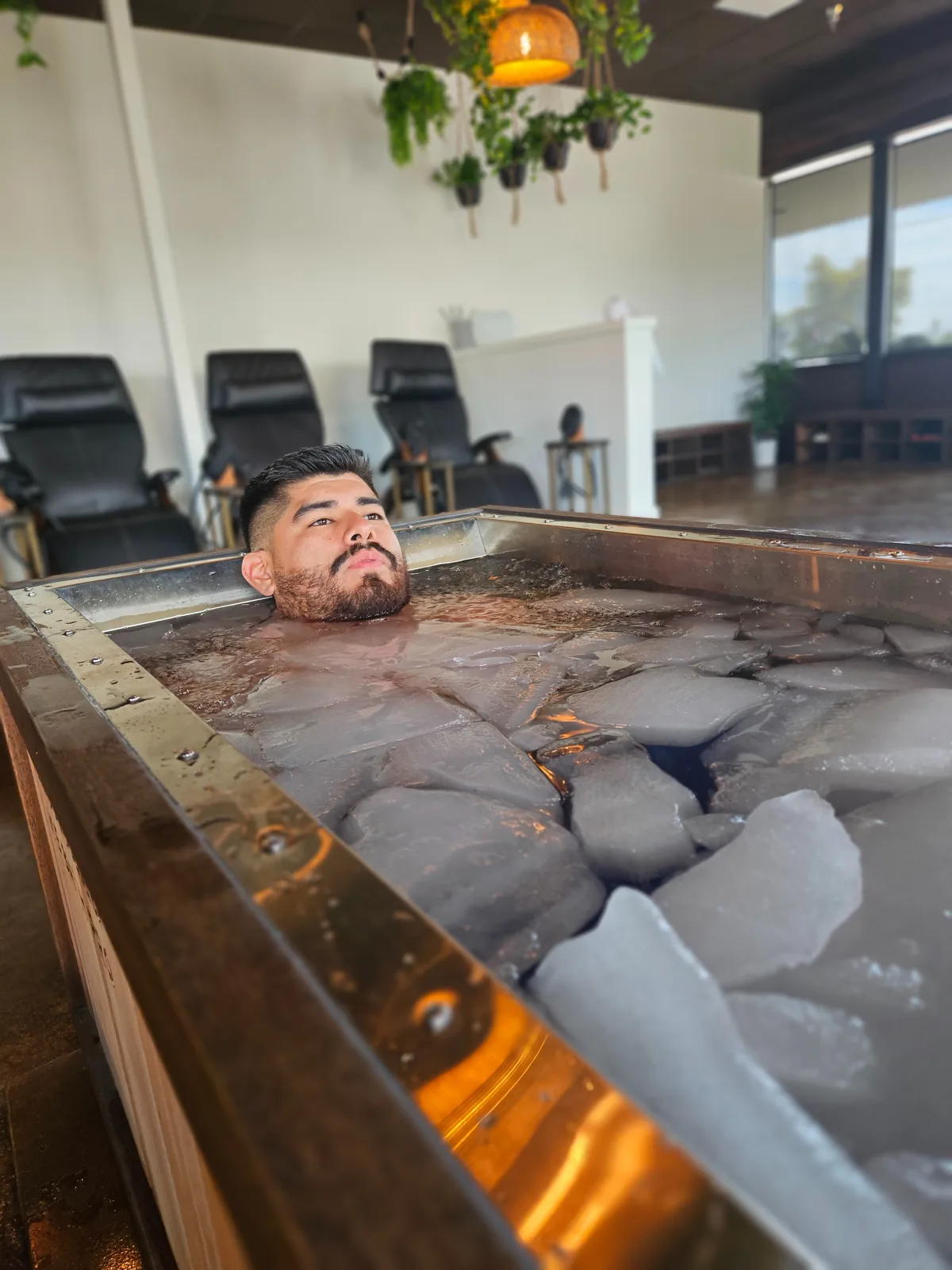
You don’t have to meet the cold alone.
More than cold water. A place to feel seen, supported, and guided one step at a time. Explore our 45°F cold plunge or 33°F ice bath with a team that puts the person before the plunge.
A safe haven. A human connection.
People come to Reconnect carrying more than physical tension. They bring full lives, fears, uncertainty, and a desire to feel like themselves again. We hold space for the whole person. Our intention is to create emotional safety: a place where you can be heard, express what you feel, and make choices without pressure or judgment.
More than 10,000 people. Every person different.
Across our facilities, we have welcomed more than 10,000 people. Our firsthand guiding experience spans ages 6 to 83, professional athletes, and people navigating profound health challenges. That experience has shaped how we listen and support each individual. It is our history, not a clinical study or a statement that cold immersion is suitable for every age or condition.
Step by step. Side by side.
We start by listening. What brings you here? What feels intimidating? What support would help? We explain the experience, agree on an approach, and stay alongside you as you take each step. You stay in control: pause, ask questions, choose a different option, or step out. There is nothing to prove.
Room to discover something new in yourself.
For some guests, the meaningful part is approaching something they once believed they could not do. Our aim is to help you explore those limiting beliefs with compassion, build trust in your choices, and discover a new sense of possibility. Tears, laughter, quiet, or simply deciding to stop can all have a place here. No particular emotional response or breakthrough is expected.
Supporting calm without forcing it.
The cold initially activates the body’s stress response. Our guidance focuses on steady, natural breathing, connection, and noticing what you feel. We create room to practice responding to a challenging sensation with support. Some guests describe feeling calmer afterward; this personal experience is not proof of a lasting nervous-system “reset” or treatment for trauma.
Two temperatures. Your own pace.
Our cold plunge is 45°F (about 7°C); our ice bath is 33°F (about 1°C). Both are intense cold exposures. The colder option is optional, and colder or longer is not automatically better. We help you make an individual choice rather than chase a time or temperature.
Emotional safety and physical suitability.
Feeling supported matters deeply, and it does not remove the physical effects of cold. We have accompanied guests during pregnancy and while living with cancer or neuropathy; those experiences do not establish safety or a treatment benefit. Pregnancy, cancer treatment, impaired sensation, and other medical circumstances need individual guidance from the treating clinician before considering immersion. Our role is support, not medical clearance.
Care that includes knowing when to stop.
Tell us about your health history before entering. Cold can rapidly increase breathing, heart rate, and blood pressure. Keep your head above water and breathe continuously—never hyperventilate or hold your breath in or around the tub. Leave promptly for chest pain, dizziness, numbness, or breathing you cannot settle. A sense of confidence never needs to mean pushing through a warning sign.
Your cold plunge and ice bath questions, answered.
Answers from Reconnect Mind Body for planning your experience in Mesa or Scottsdale, Arizona. For location details, find your Reconnect; for visit options, explore memberships and pricing.
What temperatures are the cold plunge and ice bath at Reconnect?
Reconnect Mind Body offers a cold plunge at 45°F (about 7°C) and an ice bath at 33°F (about 1°C). Both are intense cold exposures. Your health history and response help determine suitability; the colder option is optional.
What makes a guided cold plunge different from plunging alone?
A guided cold plunge at Reconnect includes a conversation about your needs, an explanation of the experience, and step-by-step support from our team. You can pause or stop at any time. Guidance supports comfort and choice but does not eliminate the physical risks of cold water.
What if I feel scared or emotional during a cold plunge?
You do not have to hide it or push past it. Tell us what you need. We can slow down, pause, or choose something else. Our support is an invitation, and you are always free to say no.
Can children or people with medical conditions use cold water at Reconnect?
Our experience includes a wide range of ages and health histories, but past participation is not a recommendation for someone else. Contact us before booking for a child or a complex health situation. A parent or guardian and the child’s clinician should be involved in deciding suitability; pregnancy, cancer treatment, or neuropathy also require discussion with the treating clinician. An alternative to cold water may be more appropriate.
Should I start with the cold plunge or the ice bath?
Discuss it with our team. The 45°F plunge is less extreme, but it is still very cold. You can choose a shorter exposure or skip cold water entirely.
How long should I stay in a cold plunge or ice bath?
There is no universal safe target. Duration depends on health, experience, temperature, and how you respond. We do not recommend copying research exposure times or trying to beat a personal record.
Can I practice breathwork or breath holds in cold water?
Use comfortable, continuous breathing only. No rapid breathing, intentional hyperventilation, underwater breathing exercises, or breath holds.
Who should get medical clearance before cold-water immersion?
Speak with your clinician first if you have heart disease, rhythm problems, uncontrolled blood pressure, Raynaud’s, impaired sensation, are pregnant, or have another condition affected by cold. Do not enter while intoxicated or unwell.
Is colder water more effective for cold-water therapy?
Not necessarily. Colder water will challenge your stress response and cardiovascular system a bit more. It truly comes down to what you need for that day and every experience is different dependent upon the state of your mind and nervous system.
A closer look at the evidence.
Published research is still developing, particularly for emotional outcomes and people with complex medical histories. We value both careful research and what guests share with us, while keeping them distinct: firsthand experience can inform our care, but cannot prove safety or effectiveness. Future studies may add answers; their findings cannot be assumed in advance.
- Effects of cold-water immersion on health and wellbeing (2025 systematic review) ↗
This review found a limited, varied evidence base; it does not validate our exact temperatures or guarantee a particular result.
- American Heart Association: cold-water immersion risks ↗
Explains the cold-shock response and why cardiovascular screening matters.
- American Diabetes Association: nerve damage and temperature sensation ↗
Explains how neuropathy can reduce the ability to sense pain, heat, and cold—one reason comfort alone cannot establish safety.
Educational information, not individualized medical advice. Discuss suitability with your clinician when you have a medical condition or take relevant medication. Research reviewed October 2026.